

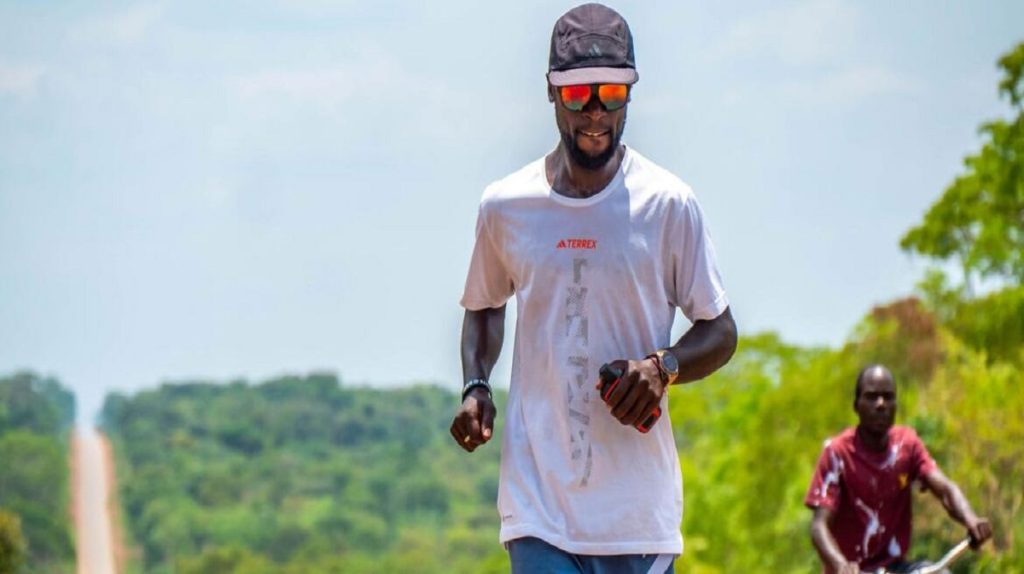
After a year and a half on the road, the Ugandan‑British runner and campaigner has become the first person to complete an extraordinary run from Cape Town to London.
Covering 13 296.4 kilometres across 21 countries, Kato transformed his astonishing physical achievement into a powerful act of activism, using the journey to challenge racism and reshape public understanding of migration.
Born in Uganda and raised in the United Kingdom, Kato initially took up running to improve his health. Over time, that discipline evolved into a mission rooted in identity, endurance, protest and hope.
The global reckoning over racial injustice in 2020, sparked by the murder of George Floyd in Minneapolis, proved pivotal for Kato. He realised his running could become a tool for social change.
“I thought, ‘I have to do something about this. Whether it’s small or big, I want to use my running to create change and speak out against racial injustice,’” he said.
Driven by that conviction, he ran ten kilometres every day for 381 days, mirroring each day of the Montgomery Bus Boycott, a defining moment in the United States civil rights movement. He told himself, “I’m going to keep doing this for as long as I can because this is how change happens.”
Day after day, Kato used his running to confront racism, spark conversations and amplify debates around migration and justice. Inspired by this purpose, Kato set out on his Cape Town‑to‑London run, symbolically tracing the pathways of early human migration from Africa into Europe.
The journey was demanding and unpredictable. He scaled mountain ranges, crossed vast deserts, and passed through wildlife reserves where the landscape changed dramatically from one region to the next. “It feels incredible just to be moving. Then, suddenly, I see elephants, and children start running beside me,” he recalled.
Along the way, Kato saw first-hand the complexities and constraints many migrants face, particularly those displaced by climate change, economic hardship or conflict. He encountered regions where limited legal pathways and strict movement controls left people unable to move freely, shutting off routes to safety and opportunity.
“Some people end up detained simply for trying to flee conflict or because they are seen as outsiders. Even when they have the correct paperwork, they can still be held,” he said.
Kato experienced similar obstacles himself. In one country, he was detained despite having the necessary documents. In others, he was forced to reroute due to conflict or restricted access.
As he approached Europe, the scrutiny increased. “The further I travelled along the migration route, the more I was viewed as an irregular migrant,” he explained. “People would call the police simply because they saw someone they thought didn’t belong passing through their area.”
For Kato, this reinforced the disparities in how movement is policed and how migrants, especially those of African descent, are often perceived.
His journey, both physical and political, has now become a powerful statement: a reminder of shared human origins, and a call for empathy, justice and a more humane understanding of migration.
–UN/ChannelAfrica–


