

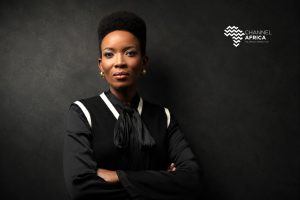

As South Africa (SA) brings Women’s Month to a close, entrepreneur Mmatsatsi Rampa is challenging traditional ideas about where women belong in business, taking her place in an industry where women, particularly Black women, remain underrepresented.
Rampa is the Managing Director of Sun Diverse Group, a 100% Black female-owned SA manufacturing company specialising in coatings, waterproofing and flooring systems. The company is based in Meadowdale, Germiston, in Gauteng province.
Her journey into manufacturing is rooted in a family legacy spanning more than three decades of knowledge in textured coatings. Growing up around the family business exposed her to both the craftsmanship behind the products and the role durable coatings can play in protecting buildings. Rather than simply inheriting that knowledge, Rampa set out to modernise it and build a business capable of competing in a changing construction and property sector.
“I chose to take the knowledge I had inherited and modernise it,” Rampa said.
Her professional journey has also been shaped by formal education. She studied human resources before completing a Postgraduate Diploma in Management at Wits University and a Master’s in Entrepreneurship and New Venture Creation at Wits Business School. For Rampa, those experiences reinforced the importance of combining technical expertise with sound business systems, strategy and commercial discipline.
Today, Sun Diverse Group operates across more than just paint manufacturing. Its offering has grown from textured wall coatings to acrylic paints, primers, sealers, waterproofing systems, damp remediation, roof coatings, industrial flooring and protective finishes. Rampa describes the company as a manufacturer, technical applicator and property-solutions partner.
But establishing herself as a technical leader in the construction and manufacturing sectors has not been without challenges.
Rampa says one of the realities she has faced is the repeated need to prove her technical credibility in environments where leadership and expertise are still often associated with men.
“In a male-dominated environment, a woman may enter a site or commercial discussion and initially be viewed as the administrator rather than the manufacturer, technical lead or decision-maker,” she said.
Her response has been to know her products, understand site conditions and allow the quality of the company’s work to establish its reputation.
There have also been broader business challenges. Access to working capital, long corporate payment cycles, limited access to major procurement networks and the cost of funding materials and labour before clients pay can place significant pressure on a growing manufacturing business.
For Rampa, being a Black woman leading a manufacturing company therefore carries a responsibility that goes beyond representation.
“Women should not only be invited into construction as administrators, intermediaries or small subcontractors. We must be formulators, manufacturers, technical decision-makers, employers and owners of intellectual property and productive capacity,” she said.
It is an outlook that has shaped how she sees the future of Sun Diverse Group.
The business manufactures the Enduraplast range of coatings and finishes. Its flagship Enduraplast Texture is described as a hydrophobic textured wall coating for interior and exterior use, designed to resist water absorption while providing a durable decorative finish. The wider range includes other finishes, waterproofing products, protective top coats, primers, acrylic paints and sealers.
Rampa says innovation is central to the company’s growth, but for her, innovation has to solve a practical problem.
“Innovation is not adding a fashionable label to a product; it is solving a recurring property problem more effectively,” she said.
Her ambition is to develop Sun Diverse Group into what she calls a “lab for properties”, a company that identifies recurring maintenance problems, tests and documents solutions and then develops systems that can be replicated across larger property portfolios.
Growth, however, is not only about expanding the company’s market share.
Rampa wants the business to create technical career opportunities for women and young people in areas including production, mixing, quality control, site supervision, waterproofing, flooring, technical sales and project administration.
“A young woman should be able to imagine herself as a formulation technician, production manager, contracts manager or owner of a specialist application business, not only in a support role,” she said.
As Women’s Month shines a spotlight on the progress made by women, Rampa believes the conversation must also confront the structural barriers that continue to restrict women-owned businesses.
She says celebrating women entrepreneurs is not enough if they remain excluded from financing, procurement networks, infrastructure and decision-making spaces.
“We need to move beyond celebrating women’s entrepreneurship symbolically and address the commercial conditions that determine whether women-owned businesses survive,” Rampa said.
She argues that access to finance needs to reflect the realities of industries such as manufacturing and construction, where businesses require equipment, stock and working capital and may have to wait extended periods for payment. She also wants procurement commitments to result in actual purchase orders, framework agreements and repeat business, rather than ending with workshops and networking events.
Her message extends beyond SA
Rampa believes women across the continent need greater access to technical education, productive infrastructure, industry information and networks where important commercial decisions are made. Ultimately, she says, the aim should be to enable women to build assets, intellectual property, factories, distribution channels and export capacity.
“That is how participation becomes economic power,” she said.
For women who may be hesitant to enter sectors where they see few people who look like them, Rampa’s message is equally clear.
“Do not wait for the industry to look familiar before you enter it. Your presence may be part of what changes the picture for the woman who comes after you,” she said.
She advises aspiring entrepreneurs to prepare themselves by learning the technical language of their industries, understanding their commercial models, knowing their numbers and building evidence of what they can deliver.
Looking ahead, Rampa wants Sun Diverse Group to become a recognised property-solutions and asset-protection partner across Africa. The company plans to strengthen its production and quality-assurance capacity, expand its application teams and distribution network, increase its presence in Durban and the Eastern Cape and eventually move into other African markets.
Her longer-term ambition is even bigger: to help build an African industrial manufacturer rooted in South Africa, creating technical jobs locally while developing solutions that can be taken across the continent.
For Rampa, that vision is ultimately about legacy.
“I want people to know that I took a family legacy in textured coatings and used it as the foundation for a Black female-owned manufacturing business with the ambition to protect assets, create jobs and build African industrial capability,” she said.
And as another Women’s Month draws to a close, Rampa’s story reflects a broader challenge facing the continent: moving women from the margins of traditionally male-dominated industries into positions where they own, manufacture, innovate and make decisions.
For her, success will not simply be measured by the products her company produces or the contracts it secures, but also by the women who look at industries such as manufacturing and construction and realise that they, too, can lead them.
–WendyMothata/ChannelAfrica–


