
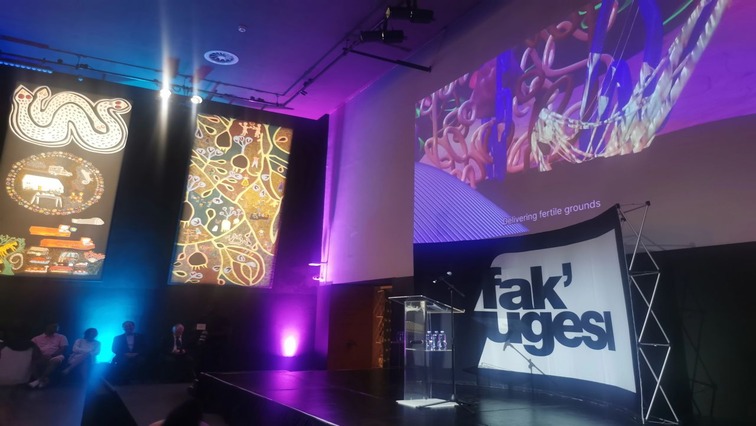
The Fak’ugesi African Digital Innovation Festival gets underway in Johannesburg, South Africa (SA) on Tuesday, bringing together artists, technologists, researchers and innovators from across Africa and beyond for five days of conversations and creative experiences exploring the continent’s digital future.
Running from October 13 – 17 the Tshimologong Digital Innovation Precinct, this year’s festival is being held under the theme “African Imaginaries”, guided by the idea that “Imagination Precedes Innovation”.
The 2026 programme examines how African knowledge, creativity and technology can shape new possibilities for the continent rather than simply respond to technological developments happening elsewhere.
Festival Director Alby Michaels says Fak’ugesi has, for more than a decade, created a platform where different disciplines can come together to imagine and build new futures.
“For a few days in October, Johannesburg becomes a living laboratory of possibility. Artists meet engineers. Designers challenge scientists. Gamers collaborate with musicians,” Michaels says.
He describes African Imaginaries as more than this year’s festival theme, arguing that imagination has long played a central role in African innovation.
“Every breakthrough begins with the courage to imagine what does not yet exist,” he says.
The festival programme is organised around three areas, Memory Engines, Imagination Engines and Future Engines.
Memory Engines explores how African communities preserve, interpret and transmit knowledge on their own terms, while Imagination Engines looks at the ways African creatives and technologists are engaging with emerging technologies, including artificial intelligence.
Future Engines turns the focus to African cities, systems and solutions being developed to address contemporary challenges.
The relationship between technology, artificial intelligence, archives and African representation is expected to feature prominently during this year’s programme.
Among the participating creatives is Ugandan digital artist Evans Akanyijuka, whose practice combines photography, collage and artificial intelligence to interrogate history, memory and the way Africa is represented.
Akanyijuka describes himself as a “student of one’s environment”, with his work raising a larger question around who gets to create and define images of Africa.
His exhibition, “Postcards from Latent Space: AI & African Photography, A Cross-Cultural Exploration”, will run throughout the festival at Tshimologong’s Engine Room.
The work investigates what artificial intelligence inherits from existing photographic archives, whose perspectives are represented in those archives and who may be excluded when machines are trained to generate new images.
Wits University, which has partnered with Fak’ugesi since its inception, says the festival has become an important space for connecting academic research with creativity, technology and society.
Wits Deputy Vice-Chancellor for Research and Innovation Professor Lynn Morris says the festival’s strength lies in its ability to break down conventional boundaries.
“What makes Fak’ugesi unique is that it brings together artists, researchers, technologists, entrepreneurs, and communities,” Morris says.
She says platforms such as Fak’ugesi also allow research and new ideas to move beyond traditional academic environments.
“It creates a valuable feedback loop between research, creativity and real-world application that is difficult to replicate within conventional academic settings,” Morris says.
Across the five days, audiences can expect exhibitions, talks, workshops, screenings, performances and immersive digital experiences bringing together practitioners working in fields ranging from artificial intelligence and gaming to digital art, archives, urban innovation and creative entrepreneurship.
For organisers, the festival is not only about predicting what Africa’s future might look like, but about recognising that African creatives, researchers and innovators are already actively building it.
Fak’ugesi 2026 runs until Saturday, October 17, at the Tshimologong Digital Innovation Precinct and other participating venues in Johannesburg.
–WendyMothata/ChannelAfrica–