


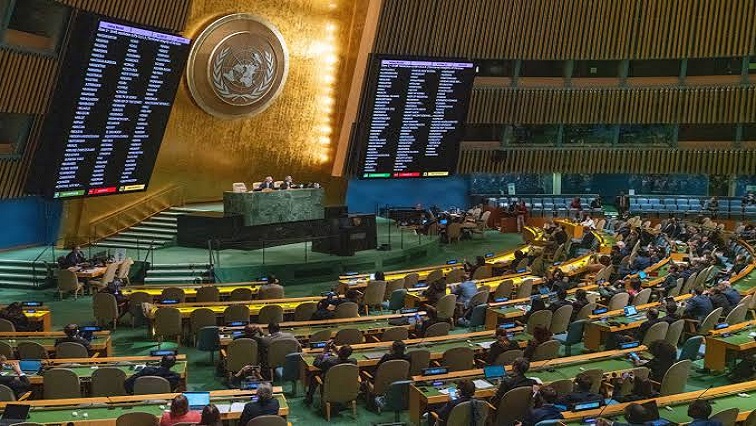
During the UN General Assembly debate in New York, governments argued that the UN could only remain credible if its structures reflected current geopolitical realities rather than the power distribution of 1945. “The UN exists because power requires rules, and humanity needs a place where power answers to principle,” UN Secretary-General António Guterres said.
Kenya said the principle of equality among countries was undermined by the composition of the Security Council. “The equality proclaimed in this Assembly ends at the doors of the Security Council,” Kenya said.
Guyana called for permanent representation for Africa, Latin America and the Caribbean. “We need a Security Council that reflects the geopolitical realities of the 21st century, not the power structures of 1945,” Guyana said.
Guterres described the absence of permanent African representation as “unjust and indefensible”, while General Assembly President Khalilur Rahman said Africa could not be expected to “wait indefinitely for its rightful place”.
Governments agreed broadly on the need for reform but remained divided over its extent.
Spain called for fairer regional representation and the abolition of veto powers held by China, France, Russia, the United Kingdom and the United States (US).
Russia supported expanded representation for Africa, Asia and Latin America but warned against reforms that weakened the authority of permanent Security Council members.
Operational reform also divided delegations. Switzerland and Costa Rica supported clearer priorities, greater efficiency and measurable results.
China warned that reform should strengthen institutional performance rather than simply reduce budgets and mandates. Guyana said UN resources should match assigned responsibilities, while Spain called for greater funding and executive capacity.
Rahman said public confidence would depend on whether the UN produced tangible results. “Outside these walls, people are not asking whether the UN still exists. They are asking whether it works,” Rahman said.
The US supported a smaller institution, citing a 15% reduction in the UN budget and the elimination of more than 4 000 positions in 2026.
Despite disagreements over funding, vetoes and institutional authority, governments broadly agreed that multilateral cooperation remained necessary. “We must not abandon multilateralism because it is imperfect,” Guyana said. “We must renew it because humanity still needs it.”
–UN/ChannelAfrica–


