


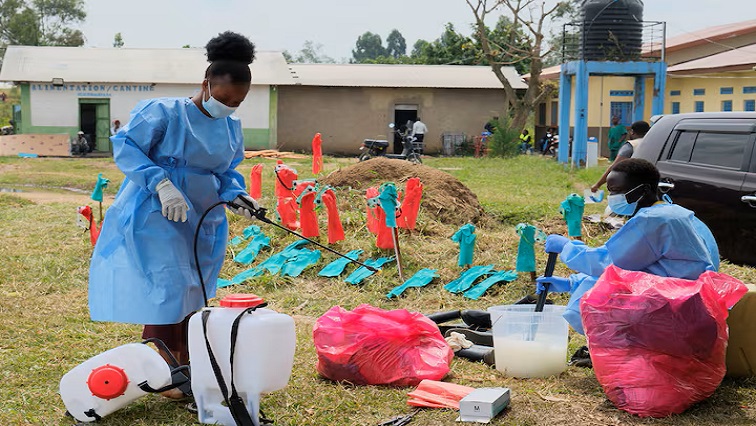
The Democratic Republic of Congo (DRC) is facing a dual public health challenge as authorities continue to battle an Ebola outbreak while dealing with a strike by healthcare workers protesting months of delayed salaries and unpaid risk allowances.
The work stoppage has raised concerns among health experts, who warn that any disruption in frontline medical services could undermine efforts to contain one of the world’s deadliest infectious diseases.
Ebola, which has primarily affected Ituri Province, has prompted an intensive response involving the Ministry of Health, the World Health Organisation (WHO), Africa CDC and several humanitarian organizations. Health officials continue to monitor neighbouring provinces, including North Kivu and South Kivu, because of frequent population movements and the potential risk of cross-border transmission.
However, the response has become increasingly complicated as doctors, nurses, laboratory technicians and community health workers have staged strikes in several public health facilities, demanding the payment of salary arrears and Ebola risk allowances.
Healthcare workers say they have remained on the frontlines since the outbreak began, often working long hours under hazardous conditions while caring for patients infected with a highly contagious virus. Many say they have not received their salaries or special risk allowances for several months.
Their demands extend beyond delayed payments. Workers are also calling for improved working conditions, adequate personal protective equipment, better medical supplies and greater transparency in the management of funds allocated to the health sector.
” We continue to expose ourselves to Ebola every day, but many of us cannot even provide for our own families because our salaries have not been paid ,” one healthcare worker involved in the strike said.
According to health workers’ representatives, the strike should not be interpreted as abandoning patients but rather as an attempt to draw attention to longstanding problems within the country’s healthcare system.
Impact on the Ebola Response
Public health experts say the strike comes at one of the worst possible moments.
Containing Ebola requires a rapid and coordinated response involving surveillance teams, laboratory technicians, vaccination teams, contact tracers and community health workers.
Every suspected Ebola case must be quickly identified, isolated, tested and investigated. Anyone who has been in close contact with an infected person must also be located and monitored for symptoms.
With reduced staffing levels in some health facilities, these operations have become more difficult.
Some hospitals have continued providing emergency services while reducing routine consultations. In certain areas, surveillance activities, laboratory testing and vaccination campaigns have slowed because fewer trained personnel are available.
Community outreach has also been affected.
Community health workers play a crucial role by visiting villages and neighbourhoods to educate residents about Ebola symptoms, encourage early reporting of suspected cases and combat misinformation.
Health specialists warn that interruptions in these activities increase the likelihood that infected individuals could remain undetected within communities, allowing further transmission of the virus.
International Partners Continue Supporting the Response
Despite the strike, the DRC Ministry of Health, working alongside the World Health Organisation and other international partners, continues operating Ebola treatment centers, laboratories and emergency response teams.
International organizations have emphasized, however, that external assistance cannot replace the national healthcare workforce.
Local doctors, nurses and community health workers possess critical knowledge of local languages, customs and community dynamics, making them indispensable to the Ebola response.
Health experts say rebuilding trust between authorities and healthcare workers is essential if the outbreak is to be brought under control.
Border Reopening Brings Relief but Requires Continued Vigilance
Meanwhile, Rwanda has reopened its main border crossings with eastern DRC after weeks of restrictions imposed to reduce the risk of Ebola transmission.
The reopening is expected to restore economic activity along one of Africa’s busiest international borders.
Thousands of people cross daily between Goma and Gisenyi for business, employment, education and family visits.
The temporary restrictions had severe economic consequences, particularly for small-scale traders, transport operators and families who depend on cross-border movement for their livelihoods.
Many market vendors lost their primary source of income, while transport businesses reported significant financial losses.
However, health authorities stress that reopening the border does not mean Ebola surveillance has ended.
Rwandan officials continue conducting health screening at official points of entry, including temperature checks and health assessments where necessary.
Authorities in both countries are maintaining close cooperation by sharing surveillance information and coordinating efforts to detect any suspected cross-border Ebola cases.
Public health specialists say the challenge now is balancing disease prevention with economic recovery.
Keeping borders closed indefinitely carries significant social and economic costs for communities that rely heavily on cross-border trade.
At the same time, relaxing public health measures too quickly could increase the risk of cross-border transmission.
For residents of eastern DRC and western Rwanda, the reopening offers hope that daily life can gradually return to normal.
But experts caution that maintaining strict surveillance, protecting frontline healthcare workers and ensuring they receive their salaries on time will remain essential if the country is to successfully contain the Ebola outbreak.
As the DRC continues confronting one of its latest public health emergencies, the effectiveness of the Ebola response may depend not only on medical resources and international support, but also on the government’s ability to address the concerns of the healthcare workers who remain at the centre of the fight against the disease.
Despite ongoing response efforts, the outbreak remains in what the WHO describes as an “expansion phase,” meaning new infections continue to outpace containment in several affected areas. Health authorities stress that rapid detection, sustained community engagement and stronger support for frontline healthcare workers will be essential to bringing the epidemic under control.
Latest Ebola Statistics as of July 9, 2026
- Outbreak declared: May 15, 2026
- Virus strain: Bundibugyo ebolavirus
- Confirmed cases : 1 759
- Confirmed deaths: 600
- Case fatality rate : approximately 34%
- Most affected province : Ituri
- Areas under enhanced surveillance: North Kivu, South Kivu and now Tshopo Province, where suspected cases have recently emerged.
- Current status: WHO says the outbreak is still expanding, with ongoing transmission driven by population movement, insecurity and challenges affecting the health response, including disruptions linked to healthcare workers’ strikes.
–Channel Africa/Jimmy Shukrani Bakomera —


