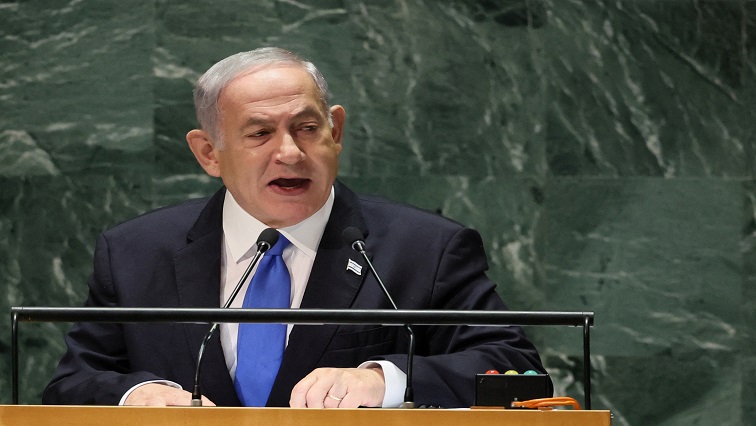
Eisenkot, a political rival of Prime Minister Benjamin Netanyahu, has 28 days to secure enough parliamentary support to establish a governing coalition. Netanyahu remains Prime Minister as the newly elected parliament takes office.
Speaking to Channel Africa on Tuesday, Political Scientist and Middle East Africa Research Institute Research Fellow Kenneth Kgwadi said Israel’s political system allowed Herzog to give the mandate to the candidate considered most likely to form a successful coalition. “The President would task one of the blocs or the candidates who garnered some votes and who is likely to form a successful coalition,” Kgwadi said.
Kgwadi said the selected candidate would be given about a month to negotiate with other parties. If the first candidate failed, Herzog could give another elected representative an opportunity to form a government. “There are about 90 days to form the government, and failure to do so would then lead to re-election, or the country would embark on fresh elections,” Kgwadi said.
Eisenkot’s immediate task is to bring together parties with differing positions on national security, military service, Israel’s relationship with Arab communities and the country’s approach to Gaza and the West Bank.
Should Eisenkot fail to secure the required support, Netanyahu could be given an opportunity to negotiate a coalition of his own.
“We are yet to see if Eisenkot will be successful in forming a coalition,” Kgwadi said. “If he fails to do so, then Netanyahu will have his chance and will have the same period to try to form a coalition.”
Eisenkot’s emergence as Netanyahu’s main challenger is significant because of Eisenkot’s background as a former Chief of Staff of the Israel Defence Forces (IDF). Kgwadi said internal security remained a leading concern among Israeli voters, particularly following the October 7, 2023, attacks. “The most significant or important issue, the priority for Israelis, has always been security or internal security in Israel,” Kgwadi said.
According to Kgwadi, voters would be looking for a leader capable of addressing those concerns while responding to the effect of the war in Gaza on Israel’s international relations.
Eisenkot’s military background could appeal to voters seeking assurances about national security. Netanyahu, however, remains an experienced political figure seeking another term as Prime Minister.
Kgwadi said Netanyahu had used security concerns to assure voters that the government would protect Israel and address the country’s deteriorating international image.
Netanyahu’s government has faced international criticism over Israel’s military actions in Gaza, which some countries, organisations and observers have described as genocide against Palestinians.
Eisenkot faces a difficult coalition-building process because Arab-Israeli parties collectively secured 19 parliamentary seats, according to Kgwadi. Those seats could play an important role in determining whether Eisenkot or Netanyahu can form a viable government.
“The winner ultimately of these elections was the Arab-Israeli majority or Arab-Israeli parties, which were able to garner 19 seats altogether,” Kgwadi said. “This is huge in the history of politics in Israel.”
Kgwadi said any candidate seeking to establish a successful coalition would need to negotiate with parties representing Arab communities.
The talks would take place against the background of strained relations between Arab communities and far-right Israeli politicians, including Itamar Ben-Gvir and Bezalel Smotrich. Kgwadi accused the politicians of hostility towards Arab communities and said socioeconomic concerns, including crime, had not received sufficient attention.
Kgwadi said statements directed at Arab communities would make coalition negotiations difficult for both Eisenkot and Netanyahu. “They would have to guarantee the Arab-Israeli parties that they are going to change relations between themselves and the Arab communities and guarantee that they are going to work well together,” Kgwadi said.
Any coalition discussions involving Arab-Israeli parties could also require negotiations about military and security policies towards Gaza and the West Bank. Kgwadi said the Arab-Israeli parties did not share the same positions as Eisenkot and Netanyahu on those issues.
The ultra-Orthodox parties could present another challenge. Kgwadi said members of ultra-Orthodox communities opposed the involvement of children from those communities in military activities. The parties representing those communities would also need to be considered during coalition negotiations.
“It will be difficult because they also have to be included in any negotiations regarding the coalition,” Kgwadi said. “This is not something that is going to be easy for either Netanyahu or Eisenkot.”
Eisenkot has publicly blamed Netanyahu for the security failures surrounding the October 7 attacks, according to Kgwadi. That position could make any political arrangement involving the two rivals more difficult.
Kgwadi said it remained too early to determine whether the election marked the end of Netanyahu’s political dominance. “It is very early because we have seen how he has been able to manoeuvre even when people thought this would be the end of Israel’s longest-serving Prime Minister,” Kgwadi said.
Netanyahu faced pressure to resign after the October 7 attacks, with demonstrators holding the government responsible for security failures. Kgwadi said protests also took place over efforts to secure the release of captives held in Gaza.
“When I was in Israel, there would always be protests,” Kgwadi said. “There were protests in Tel Aviv pressuring the government to ensure that Hamas released the hostages, but there were also parallel protests against Netanyahu in Jerusalem to try to force him to resign.”
Kgwadi said some Israelis continued to hold Netanyahu responsible for the October 7 security failures, while others still viewed the Prime Minister as an experienced and popular political leader.
“It is not going to be easy to rule him out of the political ecosystem in Israel,” Kgwadi said. “He is seen by some as a veteran who remains popular, but others want him out as soon as possible.”
Eisenkot’s military credentials could strengthen the challenge to Netanyahu as coalition negotiations proceed.
“That is why there is this rise of Eisenkot, who has a very strong military background,” Kgwadi said. “They would want somebody who comes from the IDF and who has led the IDF to ensure the security of Israel.”
–ChannelAfrica–