

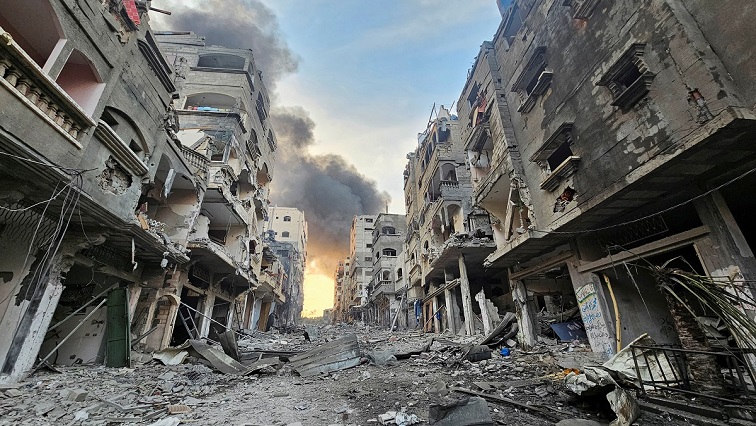
The line was established after the Israel-Hamas ceasefire agreement announced in October 2025. Most Palestinians are confined to the western zone, while the eastern zone remains under Israeli military control.
The boundary initially left about 47% of Gaza available to Palestinians. However, the UN Office for the Coordination of Humanitarian Affairs (OCHA) said Israeli forces had gradually moved the line inwards.
Palestinians now live on less than 40% of Gaza’s land.
Zeitoun resident Ibtisam Malika said the changing boundary had created a continuing cycle of displacement and return. “Every two to three months, we are forced to move and leave our belongings behind,” Malika said.
“We can’t take it anymore. We lost half of our children in the war, and only remnants of us remain.”
About 2.1 million people, almost Gaza’s entire population, are displaced and living within the limits of the yellow line, according to the UN.
Many families remain close to the painted cement blocks marking the boundary in Al-Tuffah and Zeitoun because alternative accommodation is unavailable.
“Where do we go? This is a question we’ve been asking ourselves for three years,” Al-Tuffah resident Safaa Mushtaha said. “We accepted living near the yellow line, but it’s become unbearable.”
OCHA said suitable land for displacement camps was increasingly difficult to find because much of the available territory was within prohibited or restricted areas.
About 1.98 million people, or 94% of Gaza’s population, require shelter and essential household assistance. An estimated 84% of families live in tents or shelters offering inadequate protection from the weather.
“We don’t know what to do or where to go,” Al-Tuffah resident Ola Ishtiwi said. “We don’t have a tent, and we don’t have money.”
Zeitoun resident Ahmed Arhim said continuing gunfire and drone activity prevented families from sleeping.
“The children can’t sleep. They are scared and they wet themselves,” Arhim said. “We are displaced every day, always displaced. This is not life.”
Local authorities reported 1 334 deaths and 4 429 injuries following the ceasefire announcement on October 10, 2025.
The UN Human Rights Office said 24 Palestinians, including four children and a woman, were killed in Israeli attacks over five days in late August.
“The bloodshed in Gaza must stop,” the Office said.
–UN/ChannelAfrica-


