


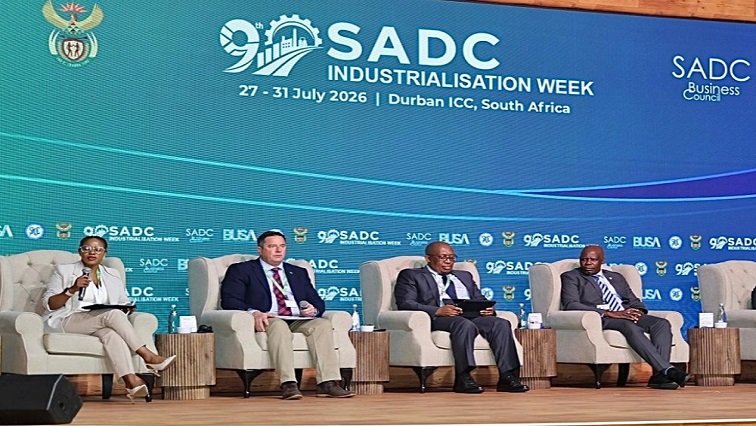
The second day of the ninth Southern African Development Community (SADC) Industrialisation Week in Durban has placed innovation, technology and local pharmaceutical manufacturing at the centre of Southern Africa’s industrial future.
Government, industry leaders and scientists say the region must invest in research, digital technologies and quality standards to strengthen healthcare, improve energy security and unlock economic growth.
The annual summit brings together government leaders, policymakers, business and industry from across Southern Africa to promote regional industrialisation and accelerate sustainable economic growth.
The Department of Science, Technology and Innovation in South Africa (SA) says technology is central to achieving those goals.
“There will be no industrialisation without innovation. We are implementing initiatives through our National Decadal Plan on Science, Technology and Innovation making sure research is ramped up and technologies are developed in SA and across SADC if we are to take advantage of the opportunities that an integrated SADC championing industrialisation could achieve,” says Department’s Director-General, Doctor Mlungisi Cele.
The SADC Accreditation Service (SADCAS) says strengthening local pharmaceutical manufacturing must go hand in hand with internationally recognised quality standards if the region is to reduce its reliance on imported vaccines.
“SADC is looking at improving health security. We have an opportunity right now to form an integrated community for the pharmaceutical industry and medical technology. The most critical investment should be in quality. COVID taught us a lot of things. One of the things it taught us is the need for us to bring our solutions closer because logistics became very difficult. We are working in the voluntary domain and with the private sector to ensure we have a region that has good quality products, with good safety, that the community can rely upon,” says SADCAS Chief Executive Officer, Eve Christine Gadzikwa.
The Medical Consortium of Africa unveiled a platform that combines satellite data with public health information to forecast disease outbreaks such as Malaria and the Foot and Mouth Disease before they occur.
“Outbreaks can be detected far ahead of time, and when we’re leveraging these sorts of technologies, the recommendations that health workers and healthcare professionals have from the platform can help them stop the spread of these diseases earlier,” says the company’s Machine Learning
Engineer, Jack Makwangela.
Innovation is also reaching traditional industries. Global paper and pulp producer, says removing regulatory barriers and expanding community forestry could help grow regional value chains while creating new income opportunities across Southern Africa.
“It’s mainly government legislation and regulations around it, how you deploy that tree and what types of chemicals and pesticides you can use to ensure that tree remains healthy both in the nursery and out in the forest. That’s the biggest stumbling block around it, and community involvement is also big. How do we get local farmers and farmers throughout Africa to grow trees as a crop and not just agriculture, as an alternative source of income,” says Forest Research, Planning and Nurseries General Manager Damian Naidoo.
—SABC—


