

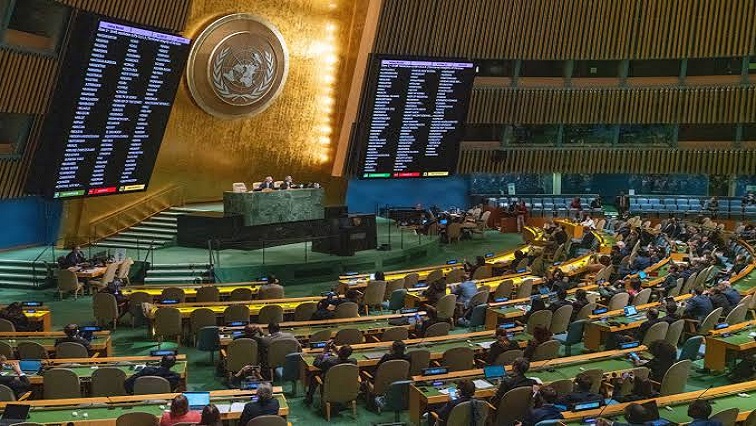
Closing six days of speeches on Monday, General Assembly President Khalilur Rahman said sharply differing perspectives had nevertheless produced a common conclusion that the United Nations remained indispensable. “Peace came first,” Rahman said, describing the demand not as a distant ambition but as an urgent defence of the UN Charter, international law and civilian protection.
The debate featured 194 speakers, including 113 Heads of State and Government, one Crown Prince, 11 Vice-Presidents, seven Deputy Prime Ministers and 48 Ministers.
Rahman warned that progress towards the Sustainable Development Goals remained severely inadequate, with only a fraction of targets on track.
Asked whether countries should have done more, Rahman said: “The answer must be a resounding yes.”
Inequality also shaped the debate. Countries facing severe debt, climate vulnerability and limited public financing frequently held the least influence over institutions responsible for global economic decisions.
Rahman said trust had become one of the most difficult deficits to repair. “Trust cannot be commanded,” Rahman said. “It must be earned through consistency between words and deeds.”
Artificial intelligence (AI) recorded a dramatic rise on the diplomatic agenda. Only five delegations discussed AI four years ago, compared with 128 this year.
Delegations raised questions about accountability, human control and equitable access, warning against allowing a few countries and companies to dominate technology shaping the global future. “No machine possesses democratic legitimacy. No algorithm inherits constitutional responsibility,” Rahman said, quoting one intervention.
Leaders also demanded deeper political reform of multilateral institutions and described Africa’s continued absence from permanent UN Security Council membership as an injustice.
Rahman said multilateralism should be judged by whether collective action “changes realities on the ground”, rather than by the number of meetings held or resolutions adopted.
The conclusion of the General Debate does not end the General Assembly session.
From October 1, detailed negotiations will move to six Main Committees covering disarmament, international security, economic, financial, humanitarian and social affairs.
The Assembly will also appoint a new UN Secretary-General following a recommendation from the Security Council. The successor to António Guterres will take office on January 1, 2027.
“This is only the beginning of the session,” Rahman said.
–UN/ChannelAfrica–


