

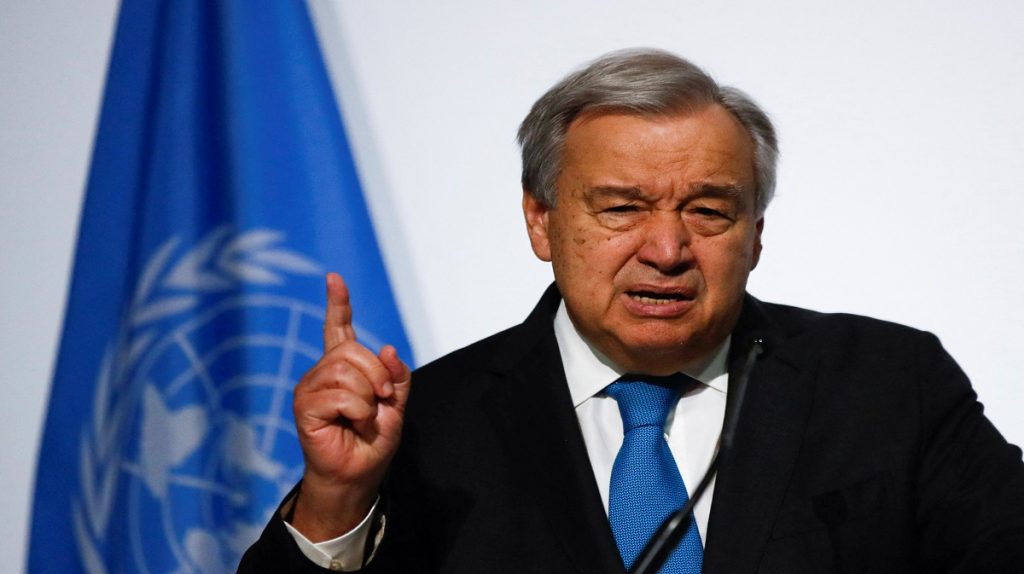
This is according to United Nations (UN) Secretary-General António Guterres, who told the UN Security Council on Monday that the surge in extremist groups is “not only a regional dramatic reality”.
He cautioned that the “progressive links” between terrorist groups in Africa and other parts of the world have made the crisis a growing global threat.
The vast Sahel region, stretching almost coast to coast across Africa, now accounts for 19% of all terrorist attacks worldwide and more than half of all terrorism-related casualties. Around four million people are displaced across Burkina Faso, Mali, Niger and neighbouring states, while essential services continue to collapse under pressure.
Guterres urged a unified, coherent and consensus-based regional response to counter the threat. He also appealed for sustained financial support for humanitarian response plans and long-term development strategies to address the structural causes of extremism.
He encouraged greater intelligence sharing and financial tracking through the UN Global Counter-Terrorism Compact and support for the Economic Community of West African States’ (ECOWAS) counter-terrorism strategy.
However, humanitarian operations remain critically underfunded, with less than 25% of the $4.9 billion required for the Sahel and Lake Chad Basin appeals raised to date.
“Terrorists thrive where the social contract is broken,” he said, underscoring the need to combat poverty and invest in sustainable development to rebuild social resilience.
Omar Alieu Touray, President of the ECOWAS Commission, warned that terrorism has spread beyond the Sahel and Lake Chad Basin to threaten all of West Africa.
He told the Council that ECOWAS is accelerating the deployment of its standby force, beginning with 1 650 personnel and scaling up to 5 000 with support from regional partners.
Touray added that while many partners have taken measures to counter terrorism, the proliferation of initiatives has caused “fragmentation” and weakened cooperation. “No amount of money, no amount of equipment will help us overcome terror if we don’t collaborate and build synergy,” he said.
President Julius Maada Bio of Sierra Leone, who also presides over the Security Council for November, called for ECOWAS to be “a community of courage, the moral compass and stabilising force of Africa”.
He urged greater democratic trust and stronger coordination in the fight against extremism, proposing an ECOWAS–UN–African Union compact to ensure predictable financing and unified operations across the region.
–UN/ChannelAfrica–


