

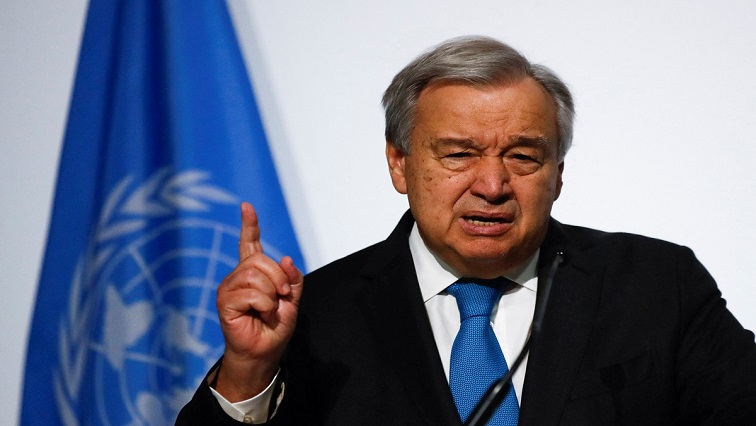
The race to become the next Secretary-General of the United Nations (UN) enters a critical new phase on Thursday when the Security Council holds its first informal straw poll to test support for the candidates seeking to lead the organisation.
The incumbent Antonio Guterres second and final five-year term ends on December 31. The Council poll, to be held behind closed doors, will be the first real indication of which of the current seven candidates are gaining momentum and which may struggle to secure the backing needed to lead the world’s largest multilateral organisation.
There is a strong push among members states for the first woman to ascend to the UN’s highest office.
Six of the seven candidates participated in a town hall hosted by the President of the General Assembly Annalena Baerbock last week.
“The person we choose will not only be the face of this house of humanity, but also its custodian. She or he will stand up for the United Nations Charter and all its three pillars peace and security, sustainable development and human rights in a time of unprecedented challenges, yet also new opportunities, “said Baerbock.
Nominations for the job had been received as late as last week and include:
*Michelle Bachelet, former Chilean President, head of UN Women and the UN High Commissioner for Human Rights;
*Maria Fernanda Espinosa – former Ecuadorian Minister of Foreign Affairs and President of the UN General Assembly;
*Rafael Grossi, Argentinian diplomat and current Director-General of the International Atomic Energy Agency;
*Rebeca Grynspan, former Vice President of Costa Rica and the current head of the UN Conference on Trade and Development;
*Carolyn Rodrigues-Birkett, a former Guyanese Foreign Minister and currently its Ambassador to the UN;
*Macky Sall. former President of Senegal;
*And veteran Ugandan diplomat Olara Otunni, nominated just days ago and not part of the debate where candidates were asked what made them the best person to lead the United Nations.
First it was Chile’s Michelle Bachelet. “I’m a tested leader with extensive political experience. I was twice president of the Republic in my country. President of the Republic is present as head of state but also is head of government. I proved I can lead complex negotiations and make difficult choices.”
Ecuador’s Maria Fernanda Espinosa said she will listen to every voice. “I have led this House; you elected me as president of the General Assembly. And in that role, I work with every member state. I listen to every voice. I build consensus. Even in the most difficult times.”
Argentina’s Rafael Grossi said he can deal with sensitive issues.
“Multilateralism can deliver. And I say this because I live it and I live it every day. I live it through the work of an organisation dealing with one of the most dangerous, sensitive and gravest of areas in international life nuclear weapons, nuclear safety. And we, through the International Atomic Energy Agency have been able to act.”
The race is also being shaped by an unofficial but long-observed principle of geographical rotation with this cycle being the turn of Latin America and the Caribbean.
This was Costa Rica’s Rebeca Grynspan answering why she felt best equipped to lead the UN.
“ I am running because what we do here in this home matters for people struggling to be free from want, from illness and from fear, because we, nations, large and small, cannot hold the charter as our anchor in a turbulent world and because people are losing trust in the capacity of this organisation to deliver peace in a more dangerous, more complex world, I am running to give them real solutions and honest answers.”
Guyana’s Caroline Rodrigues-Birkett focused on unity among people. “I have also had the approach of building bridges, uniting people around common goals and objectives, and ensuring fairness. These are the attributes that I believe we need in the next Secretary General, and this is why I have put forward myself so that we can work together to make the UN fit for purpose, for now and for the future.”
There are two candidates from Africa including Senegal’s former head of state Macky Sall.
“ I bring national experience. As a former head of state, built over nearly 40 years of public service. I have learned to listen, dialog and take difficult decisions. Secondly, I bring regional experience, including as Chairperson of Economic Community of West African States.”
The UN Security Council begins the process of selecting one of these candidates on Thursday but a final recommendation to the General Assembly that appoints the next UN Chief is at least weeks if not months away.
All 15 council members participate in the secret ballot including the five permanent members that hold veto powers over any decision.
The first straw poll will use identical white ballots, so diplomats will know only the overall level of support for each candidate.
Later rounds become more revealing. The five permanent members switch to red ballots while the 10 elected members continue using white ones.
Although individual votes remain secret, the colour of the ballot shows whether opposition is coming from a veto-wielding permanent member, a potentially fatal blow to any candidacy moving forward.
–SABC–


