
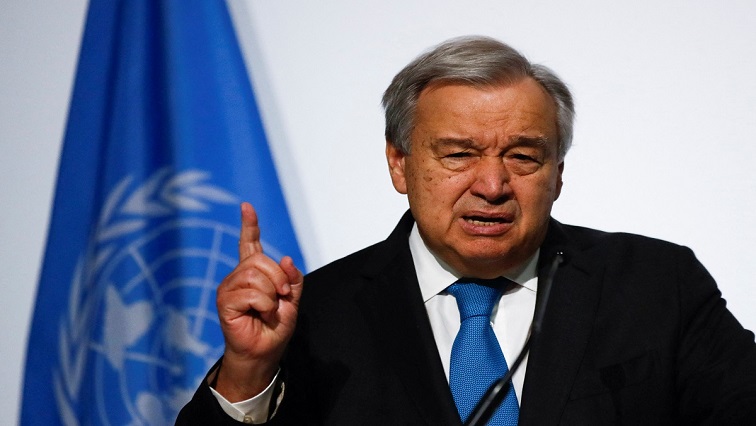
UN Secretary-General António Guterres will co-host the Bridgetown Special Summit on AI Safety with Barbados Prime Minister Mia Mottley.
The meeting will open discussions on a proposed multilateral framework for managing AI risks through independent and credible oversight. “It’s not a treaty, it’s not regulation, but it is a framework which different countries can then use to build up their own national AI safety infrastructure,” UN Special Envoy for Digital and Emerging Technologies Amandeep Singh Gill said.
Concerns about artificial intelligence have risen rapidly among world leaders. At the UN General Assembly’s high-level week in 2026, 135 leaders raised concerns about the technology, compared with three in 2017.
Gill said initiatives calling for stronger control of advanced artificial intelligence systems had gained increasing international support. A Norway and Finland-led initiative on frontier models had been signed by 32 countries and the European Commission, while another call issued at a summit hosted by France had received support from 17 countries and 10 artificial intelligence developers.
The UN said AI could strengthen healthcare systems, improve hurricane forecasting, accelerate scientific research and transform education. However, many countries lacked the computing capacity, technical expertise and institutions required to test models developed elsewhere and respond to cybersecurity incidents.
High-income countries had about 500 incident-response teams, compared with only six in low-income countries. “These AI risks don’t recognise borders,” Gill said. “Models may be developed in a couple of geographies, but the risk can travel anywhere, and the capacity is not there to deal with those risks.”
About 150 participants are expected to attend the hybrid summit, including government ministers, AI industry leaders, safety-institute executives and members of the UN Independent International Scientific Panel on AI.
The US will be represented by a senior diplomat, while experts from China are expected to attend. Military applications of AI will not form part of the discussions. A separate roundtable will consider access, inclusion and linguistic diversity amid concern that developing countries could miss the economic and social benefits of AI.
The meeting is not expected to produce a negotiated agreement, although participating governments and organisations could announce pledges and calls to action.
Gill said international understanding of AI risks had advanced, but governments now needed to translate the analysis into practical safety systems. “We are in a good position, but action must catch up with the analysis,” Gill said.
–UN/ChannelAfrica–
Image: Reuters





